Made-to-measure wooden walk-in wardrobes in Cabra
Before you get to styles, a wooden walk-in wardrobe raises a question about materials: which parts are real wood, which are veneer and which have a decorative finish. The look, the upkeep and the price all depend on that answer. If you are looking for made-to-measure wooden walk-in wardrobes in Cabra, here we run through the options that can be combined, where each one pays off, and how to choose tone and grain using real samples in your own room.
Shape your next wardrobe.
Try out the measurements, plan the interior layout and choose your finishes. See your idea take shape and share it with us so we can prepare your quote.
Send us your configuration with your measurements and we'll give you a guide price within 24 hours, free of charge. The measuring visit at your home comes afterwards.
Deciding where you want visible wood
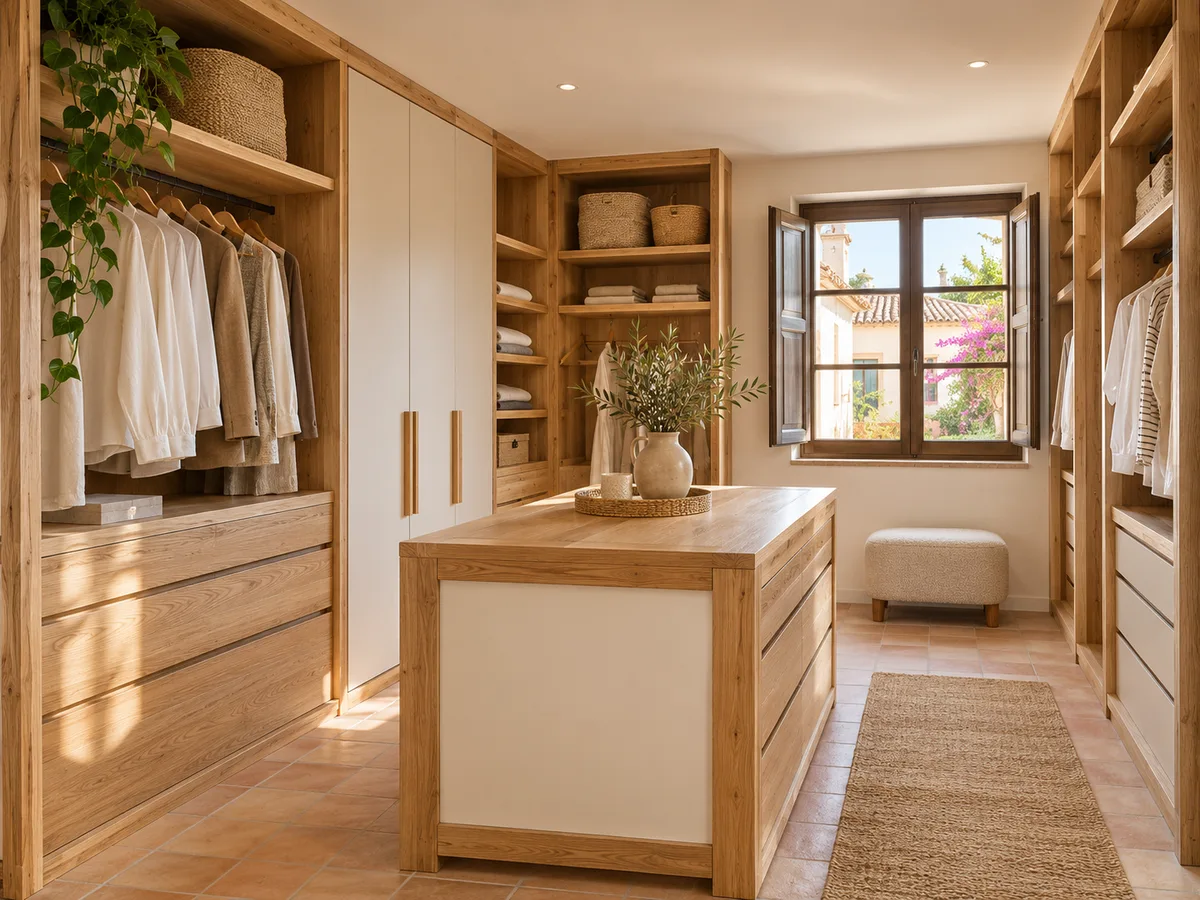
Not every part of the walk-in wardrobe needs the same material. The sensible approach is to start by marking up the plan with the surfaces you will see and touch: the drawer fronts, the shelves at eye level, the side panels at the entrance and the board that frames the mirror. That is where a wooden walk-in wardrobe makes itself felt and where high quality is worth paying for. The back panels, the bases of the units and the insides of the drawers are almost never looked at, and they can take a plainer solution. Drawing this map of "visible wood" before asking for figures is the best way to control the cost without losing impact.
Solid wood, natural veneer and decorative board
These are three families with different characteristics. Solid wood is a whole piece of timber: it can be sanded and repaired and ages with character, but it moves with changes in humidity and is heavier. Natural veneer is a thin sheet of real wood bonded to a stable board; it gives the same grain with less movement and usually costs less than solid wood. Decorative board imitates wood with a printed or melamine layer, stands up well to wear and is easy to clean, but it lacks the depth of a genuine grain. None is better in the abstract; each suits a different part of the furniture.
Structure, doors and accessories
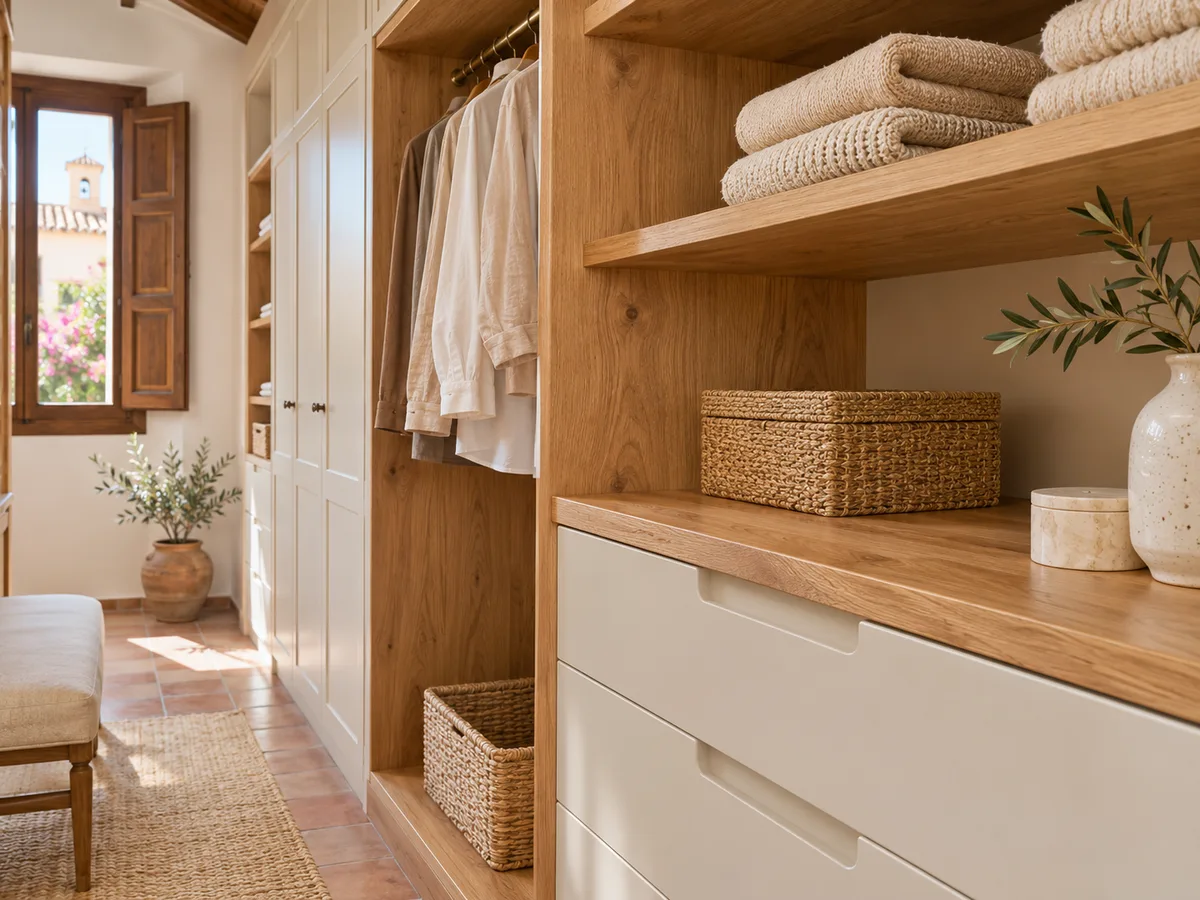
A walk-in wardrobe is made up of parts with different demands. The structure that carries the weight of your clothes is usually a good-density chipboard or fibreboard with protected edges. The drawer fronts and visible shelves are the candidates for natural wood or veneer. Accessories such as rails, trouser racks or shoe racks can be metal or wood depending on the style. Thinking of the walk-in wardrobe in terms of component types means you avoid paying for solid wood where it can't be seen and skimping where you touch it every morning. A good materials list states, unit by unit, what each element is made of.
Have you already measured the space?
Send us a photo and the approximate measurements on WhatsApp and we'll give you some initial guidance.
Tone, grain and physical sample
Oak, walnut, ash and chestnut look nothing like one another, and even within a single species there are very different tones depending on the finish. A strong grain reads on a four-metre wall as one continuous pattern, whereas a fine grain gives a calmer backdrop. To decide, you need to see samples of around 20 by 30 centimetres, hold them up against the floor and wall of the room and look at them at different times of day. In Cabra, where many rooms get intense sunlight, the same varnish can look lighter than the small catalogue sample suggested.
Combining wood with other surfaces
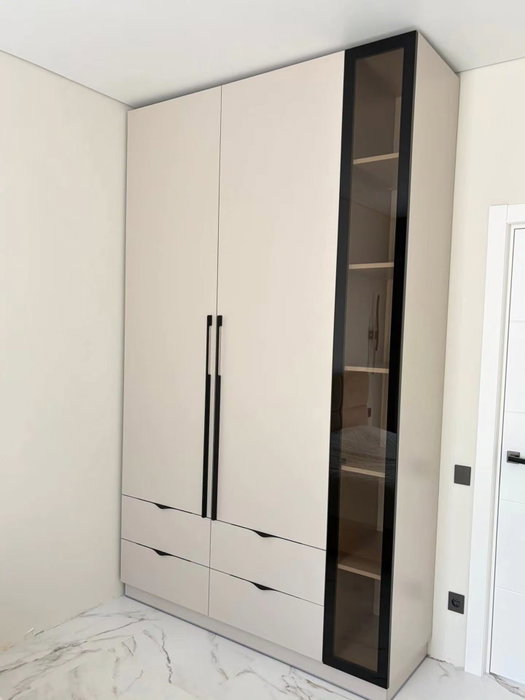
A wooden walk-in wardrobe works best when it is paired with other materials. A matt lacquer lightens large columns; smoked glass protects accessories without blocking the view; black metal or brass on rails and handles adds contrast. A useful rule is to limit the scheme to the main wood, one neutral colour and one accent. When the grain is the star, plain surfaces around it work better than anything that competes with it. If you mix two species of wood, it is better for their tones to be clearly distinct rather than almost matching without quite meeting, because the latter looks like a fitting mistake.
Latest work by SI, ARMARIO
@si.armario
Made-to-measure wardrobes and walk-in wardrobes
Latest posts
Cleaning and performance by finish
Each material has its own routine. Varnished solid wood is cleaned with a well-wrung damp cloth, and appreciates a coat of oil or wax from time to time if the finish is natural. Lacquered veneer copes well with everyday contact, but will mark if knocked by a buckle or a bag. Decorative board tolerates ordinary cleaning products and needs almost no maintenance. In a walk-in wardrobe with strong heating or very sunny windows, natural wood may lighten or open up slightly over the years, which is part of its character and is allowed for at the design stage with well-planned joints.
Ask us to come and measure up in Cabra
- 01You leave us your name and your area.
- 02We message you on WhatsApp to agree a day.
- 03The measuring visit costs €50 and is free if you place an order.
How the material affects your quote in Cabra
The material is one of the factors that moves the price most. A walk-in wardrobe in solid wood for every visible part costs clearly more than one in natural veneer, and that costs more than one in decorative board. The thickness of shelves and fronts, the number of drawers and the type of fittings also count. That is why it pays to set priorities: which parts you want in genuine wood and which can be substituted. In the configurator you can put your walk-in wardrobe together and specify the material for each area. The team replies with an indicative price within 24 hours of receiving the design with the measurements.
Edges, banding and joints that show the quality
With a piece of wood, the first thing you examine is the edge. A well-applied natural veneer edge repeats the grain of the face and is barely noticeable; a plastic one can be felt to the touch and may lift at the corners with use. In solid wood, care is taken to run the grain in the right direction and to keep joints away from where the most weight rests. For long shelves of over 80 centimetres, a reinforcement or a greater thickness is added, because wood loaded with clothes tends to bow over the months. These are small details that are worth discussing before the materials list for the walk-in wardrobe is fixed.
Choosing between a modern or rustic style
Wood does not decide the style on its own; that comes down to how it is cut, joined and finished. With straight lines, plain fronts and light tones, the same natural wood gives a modern walk-in wardrobe. With a strong grain, warm tones and handles with character, the result leans towards rustic. Whether you choose the material first and the style second, or the other way round, depends on how you think about your home. If you already know which way you are heading, there are dedicated pages for each style. As for the practicalities, the measuring visit in Cabra costs €50 if you don't order the walk-in wardrobe and is free if you do, and manufacture takes around 2 to 3 weeks.
Enquiry
Tell us about your project in Cabra
- 1We read your message and look at your photos.
- 2We reply on WhatsApp with a first figure.
- 3We measure up and prepare the final quote. The measuring visit costs €50 if you don't go ahead with the order and is free if you do.
We don't cut a single board until you've approved the design and the price.
Questions
Frequently asked questions about wardrobes in Cabra
After installation: warranty and care for your wardrobe.
What is the real difference between solid wood and natural veneer?
Solid wood is whole timber from top to bottom; veneer is a thin sheet of wood on a stable board. They look very similar, but veneer moves less with humidity and costs less, whereas solid wood can be sanded and repaired with more scope.
Can I mix natural wood with decorative board in the same walk-in wardrobe?
Yes, it is the most common approach. Natural wood is used for what you see and touch, and decorative board for the structure and back panels. If the samples are well chosen, the transition goes almost unnoticed.
Which wood looks best in a room with little light?
Light tones, such as natural oak or ash, reflect light better. Dark tones, such as walnut, work if the walk-in wardrobe has its own lighting and light walls around it.
Can I order a wooden walk-in wardrobe in a single colour without a strong grain?
Yes. There are veneers and boards with a very fine grain and an even tone. They look calmer and suit understated styles well.
How much does the price change between materials?
Quite a lot: from lowest to highest cost, it usually runs decorative board, natural veneer, then solid wood. The exact difference becomes clear once the design is settled, which is why it helps to mark on the plan which areas will use each material.
Shall we talk about your project?
Send us a photo of the space and some approximate measurements on WhatsApp: we'll give you some initial guidance and arrange the measuring visit.