Made-to-measure shallow wardrobes in Cabra
A hallway, an entrance area or the strip of wall behind a door rarely offers sixty centimetres of depth, but it will almost always take a slimmer piece of furniture. We design made-to-measure shallow wardrobes in Cabra for those spaces where a standard model won't fit or takes up too much room to walk past. Here you'll see how to measure the depth you can really use, what you can store with limited depth and which doors let you move about without bumping into them.
Shape your next wardrobe.
Try out the measurements, plan the interior layout and choose your finishes. See your idea take shape and share it with us so we can prepare your quote.
Send us your configuration with your measurements and we'll give you a guide price within 24 hours, free of charge. The measuring visit at your home comes afterwards.
Overall depth and usable depth: what changes in your wardrobe
The total depth is how far the wardrobe sticks out from the wall to the front; the usable depth is what's left for storage once you've deducted the thickness of the doors, the back panel and the fittings. In a shallow wardrobe that difference matters a great deal: with a total depth of forty centimetres, the usable depth may be only thirty-five, and those five centimetres decide whether a chunky jumper goes in face-on or not. That's why we measure the depth at several points of the space, at floor level and at shoulder height, and never rely on a single measurement.
What fits in thirty centimetres of depth
You can fit more into a shallow wardrobe than you might think. Thirty-centimetre shelves are good for towels, folded bedding, books, jars and shoe boxes set on their side. In a shallow forty-centimetre wardrobe you can store folded shirts and trousers in stacks, but not clothes hanging on a standard hanger. For shoes, a tilted or two-row shoe rack makes use of the height without going beyond the depth. If you also keep the ironing or cleaning kit there, a tall door with reduced depth hides it all. A narrow wardrobe in Cabra is perfect for the entrance: everyday coat, bags, keys and umbrellas behind a front you barely notice.
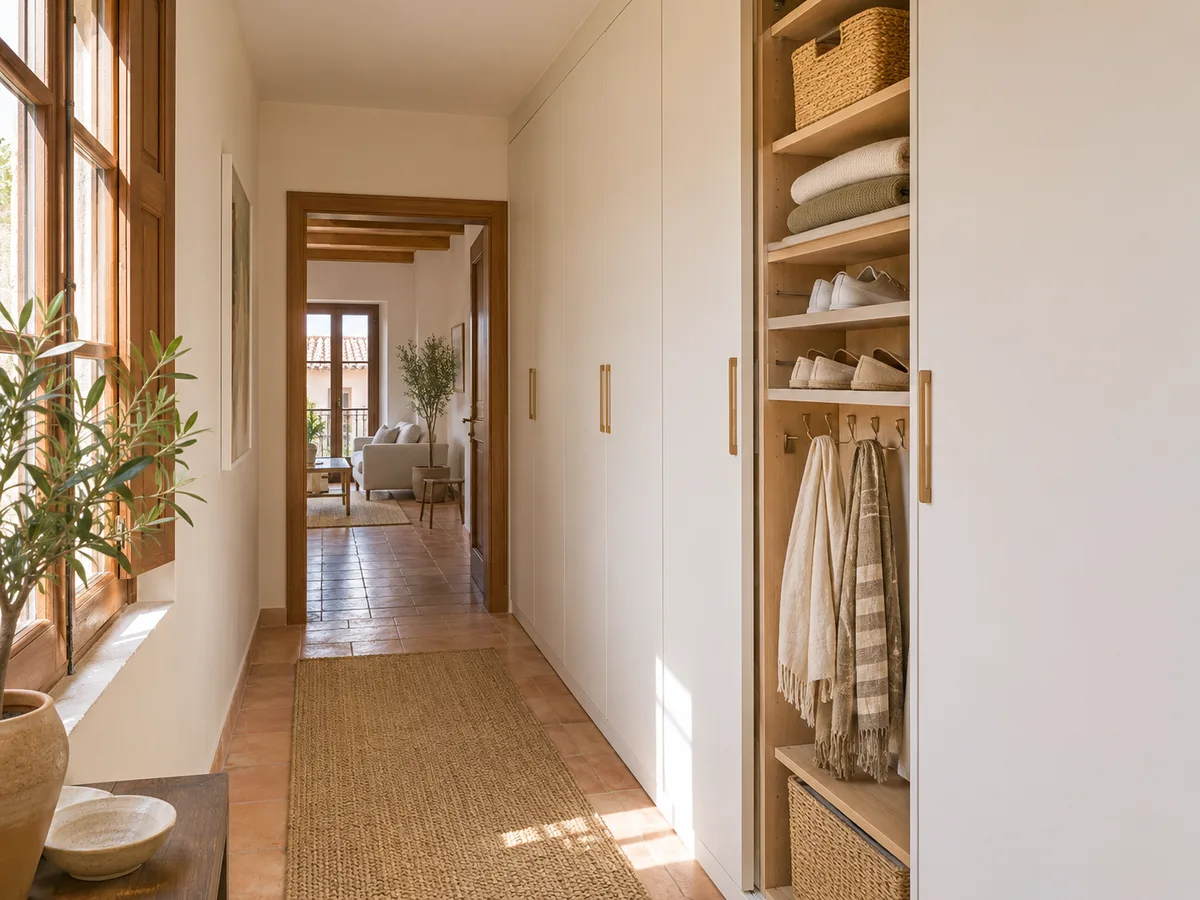
Shelves, shoe rack and front-mounted hooks
When you need to hang clothes in a shallow wardrobe, the most common solution is to turn the rail: instead of running from side to side, the hangers face the front, with a pull-out hanger that brings the garment out towards you. With thirty-five usable centimetres, this arrangement calls for slim hangers and lightweight garments. For everything else we use fixed shelves, pull-out trays and a gently tilted shoe rack. Each element needs a stop to keep what's stored from tipping against the door, which matters more in a shallow space than in a roomy one.
Have you already measured the space?
Send us a photo and the approximate measurements on WhatsApp and we'll give you some initial guidance.
Doors that respect walkways and nearby furniture
A shallow wardrobe usually has a walkway in front of it, and that's where the door makes a big difference. A hinged door swings through an arc and can get in the way if there's a chest of drawers or a bedroom door nearby; sliding doors don't stick out, but the tracks take away some of the usable depth, and in a shallow piece those centimetres are noticeable. Between the two comes the bifold door, useful if the space to move is very short. In a hallway in Cabra ninety centimetres wide, a sliding front leaves the whole passage clear, although it isn't always the best idea: it depends on how much width you have and what's going to be stored inside.
How we deal with skirting boards, pillars and uneven walls
A shallow space is often full of obstacles: a thick skirting board, a protruding pillar, a radiator, pipework running down the corner. With so little depth, every centimetre counts, so the wardrobe is drawn to fit snugly around those obstacles. The skirting board is cut back at the side, the pillar is worked around with a narrower module and walls that aren't plumb are compensated for with an adjustment filler panel. If there are pipes or cables, an access hatch is planned so you can reach them without taking the unit apart. When the ceiling isn't level or the wall has a wide moulding, we add a front that goes right up to the ceiling with a made-to-measure trim. The aim is for the wardrobe to look as if it had grown out of the wall, not like a patch-up job.
Latest work by SI, ARMARIO
@si.armario
Made-to-measure wardrobes and walk-in wardrobes
Latest posts
What measurements and photos to send so we can study the space
To assess a shallow space you need only a few measurements, but they must be good ones: width of the wall, height to the ceiling, depth at three points, distance to the nearest door and the position of sockets, switches and radiators. One photo straight on and another at an angle help us see skirting boards, mouldings and corners. If the wardrobe is going in a hallway, add the clear width at the narrowest point, because that sets the maximum depth possible. If you're unsure about any measurement, it's better to take it twice and note the difference. With that information the configurator prepares a design that the team goes over with you before any measurement is fixed.
Ask us to come and measure up in Cabra
- 01You leave us your name and your area.
- 02We message you on WhatsApp to agree a day.
- 03The measuring visit costs €50 and is free if you place an order.
What kind of finish suits a narrow wardrobe
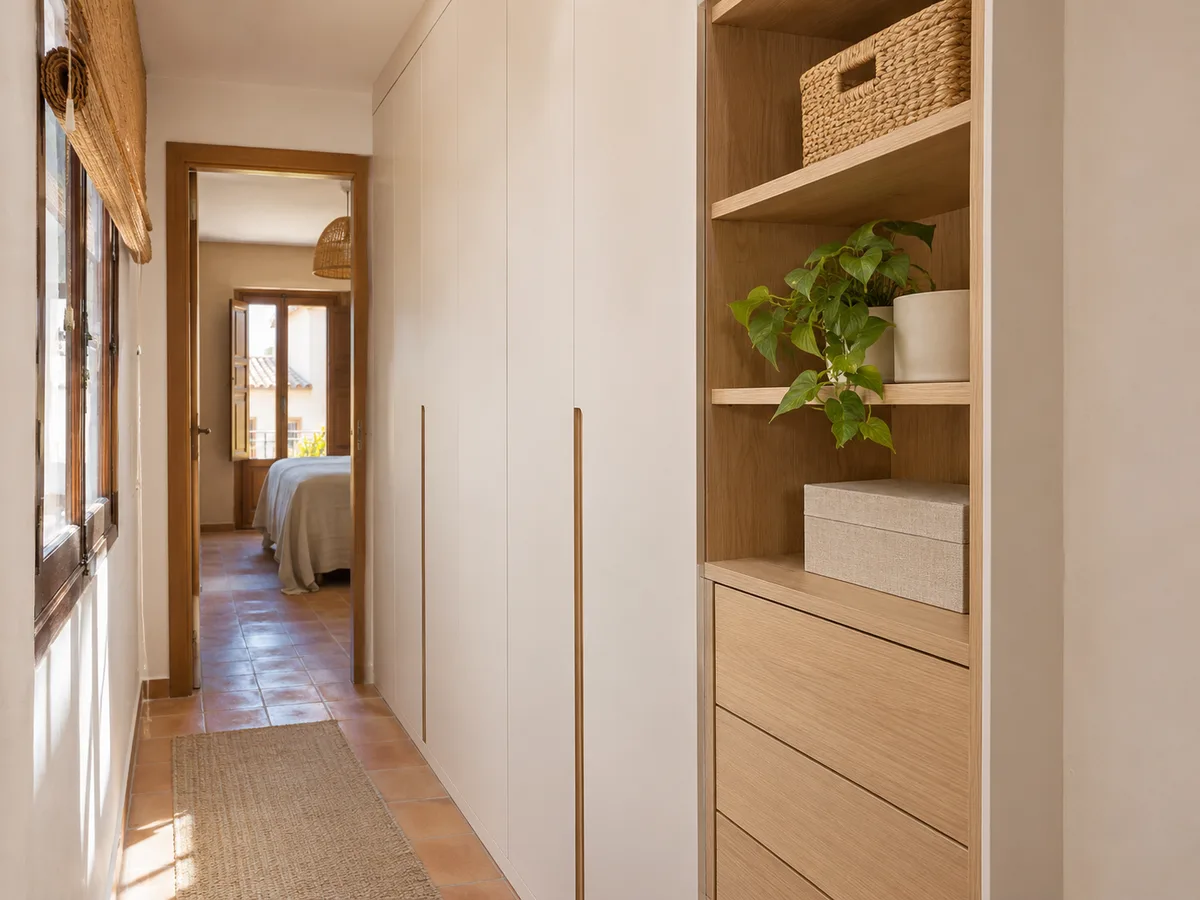
In a passageway, the colour of the wardrobe affects the sense of width. Light, matt finishes reflect the light and make a hallway feel less enclosed, whereas dark tones work better in a spacious entrance hall. A smooth front with no protruding handles avoids catching on clothes and on people passing by; a recessed finger-pull handle or push-to-open are common options. Inside, the colour of the back panel makes a big difference: a light back panel makes the shelves look deeper than they are and makes it easier to see what's at the back.
Quote and final check in Cabra
The price of a shallow wardrobe depends mainly on its height, its width and the type of door; slim units aren't necessarily cheaper, because they use almost the same hardware as a wide one. The team gives you a guide price within 24 hours of receiving the configuration with your measurements. The measuring visit costs €50 if you don't place an order and is free if you do, and manufacturing takes 2 to 3 weeks on average. Before manufacturing, every measurement is checked, with particular attention to the depth, and we confirm that the doors you've chosen will fit in the space you leave free in front. That final check avoids surprises at installation.
Enquiry
Tell us about your project in Cabra
- 1We read your message and look at your photos.
- 2We reply on WhatsApp with a first figure.
- 3We measure up and prepare the final quote. The measuring visit costs €50 if you don't go ahead with the order and is free if you do.
We don't cut a single board until you've approved the design and the price.
Questions
Frequently asked questions about wardrobes in Cabra
After installation: warranty and care for your wardrobe.
Can you design a wardrobe with a depth of 40 cm?
Yes, and it's a common depth in hallways and entrance areas. With a total depth of forty centimetres you can make good use of shelves, shallow drawers and a tilted shoe rack. For hanging clothes we use a front-facing rail or slim hangers.
How do you hang clothes in a shallow wardrobe?
With a turned rail, so that the hangers face the front. We also use pull-out hangers that bring the garment out towards you. In both cases lightweight garments and slim hangers work best.
Are sliding doors always the right choice for a shallow depth?
Not always. They avoid the swing arc, but the tracks take a few centimetres off the usable depth, which you notice when the wardrobe is very narrow. It's decided based on the space you have in front and what you plan to store.
Can you put a wardrobe in a hallway without closing it off?
Yes, with a unit between thirty and forty centimetres deep and sliding or bifold doors. We measure the clear width at the narrowest point and design the wardrobe to leave a comfortable passage.
What if the space is less than 30 cm deep?
It's possible to make shallow modules for books, tinned food or utensils, but not for clothes. In that case we suggest a unit of shelves and boxes with a plain front, serving one specific purpose.
Shall we talk about your project?
Send us a photo of the space and some approximate measurements on WhatsApp: we'll give you some initial guidance and arrange the measuring visit.